
Introduction: Customer satisfaction and product quality are essential for any company aiming for excellence in the highly competitive business world of today. Because of inefficiencies and disjointed procedures that impede advancement, traditional quality management methods frequently fall short. Quality management systems’ state-of-the-art features fill the need. Traditional product development can be slow and costly. But with Advanced Product Quality Planning (APQP), manufacturers can save 27-47% of time in planning and validation. This blog post will discuss the impact of APQP on new product development and how we can follow the APQP steps.
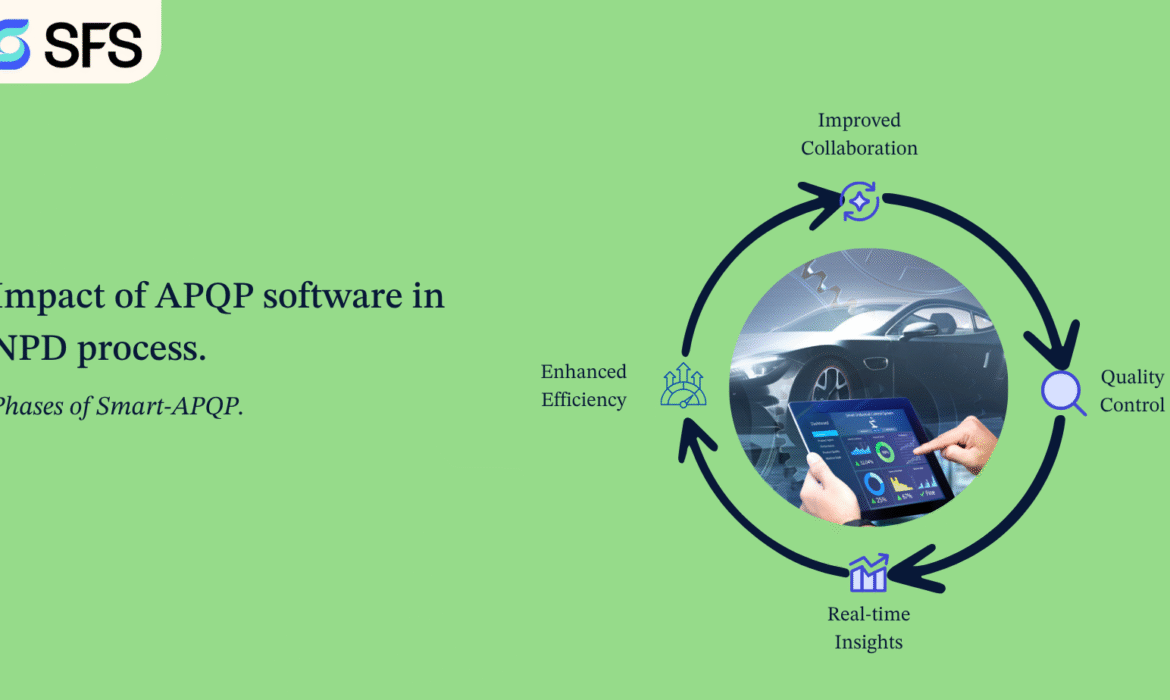
The impact of APQP software in the new product development (NPD) process: By increasing productivity, quality and teamwork, APQP (Advanced Product Quality Planning) software greatly enhances the New Product Development (NPD) process. Important effects include:
- By leading teams through specific phases including planning, design, validation and production, APQP software guarantees a methodical approach.
- This allows proactive steps to be taken to avoid design or manufacturing problems by identifying potential risks early in process. And early risk detection makes proactive solutions possible to prevent costly design or production problems.
- Communication between suppliers, stakeholders and cross-functional teams is improved by centralised platforms.
- By keeping thorough records of procedures, APQP software guarantees traceability and adherence to industry requirements.
- APQP software speeds up product launch schedules by simplifying processes, cutting down on mistakes and enhancing decision-making.
- Enhances consistency and quality by making sure each stage of NPD adheres to a standardised methodology.
- Facilitates seamless communication between design, engineering and manufacturing teams.
- Provides real-time insights for informed decision-making, reducing errors and rework.
- Maintains detailed documentation to ensure regulatory compliance and streamline audits.
- APQP software expedites product launches and minimises delays by optimising workflows and enhancing coordination.
Case study on how organizations benefit from smart APQP software for new product development.
A leading automotive company struggled with product launch delays, inconsistent designs, and poor team communication during the new product development (NPD) phase. The company is facing difficulty in keeping track of project timelines and milestones.
Solution Implemented: To improve the efficiency of their NPD process, the company implemented Smart APQP (Advanced Product Quality Planning) software. Among the key elements utilised were:
- 45% Faster Risk Identification – Detect & resolve potential failures early.
- 32% Quicker Feasibility Approvals – Reduce delays with structured reviews.
- 42% Time Saved in PPAP Submissions – Fewer iterations, faster approvals.
- 37% Faster Time-to-Market – Improve efficiency and reduce rework.
What are the phases of Smart-APQP?
Phases of APQP: The APQP process is composed of five phases:
- Planning: The goal of the first stage of APQP is to comprehend and specify the needs of the client. This entails having in-depth conversations with the client to comprehend their requirements, expectations, and specifications. At this point, developing a plan for product quality is essential. The project’s objectives, deliverables, and scope are described in this plan. To determine whether the project can be finished within the specified restrictions, a feasibility study is carried out. To guarantee that the finished product satisfies the required quality standards, it is crucial to identify significant design and process characteristics.
- Product Design and Development: The emphasis switches to developing a comprehensive product design throughout the product design and development stage. This include creating prototypes, carrying out design assessments, and creating design specifications. During the design phase, potential failure modes are identified, and remedial measures are taken to mitigate them using tools like Failure Mode and Effects Analysis (FMEA). Another crucial tool for making sure the product design is optimised for effective manufacturing and assembly procedures is Design for Manufacturability and Assembly (DFMA).
- Process Design and Development: During the process design and development phase, the product’s production process is designed. Creating process flow charts that describe every stage of the manufacturing process is part of this. Finding possible failure modes in the production process and implementing remedial measures to lessen them are made easier by conducting process FMEA. To guarantee that the production process continuously yields high-quality products, control plans must be created. The techniques and procedures that will be employed to keep an eye on and manage the production process are described in control plans.
- Product and Process Validation: Production trials are used to validate the manufacturing process and product during the product and process validation phase. This involves carrying out capability studies to evaluate the manufacturing process’s capacity to generate goods that satisfy requirements. Pilot production runs are conducted to identify and address any issues before full-scale production begins. Initial sample inspections are performed to ensure that the product meets all specifications and requirements.
- Feedback: Continuous improvement is the focus of the last stage of APQP. This include getting consumer input, evaluating how well the production process is working, and taking remedial action when necessary. The objective is to maintain and improve product quality over time. Continuous improvement is a key principle of APQP, essential to ensuring that the product and manufacturing process continually meet customer requirements and expectations.
Conclusion: To put it briefly, Advanced Product Quality Planning (APQP) software guarantees product quality, lowers expenses and aligns procedures for effective New Product Development (NPD) results. Through the integration of fundamental quality management procedures with user-friendly project management software, businesses can produce better goods, surpass client expectations and stay ahead of the competition. By adopting Smart APQP software, the manufacturer achieved faster product launches, improved quality control and enhanced team collaboration, significantly boosting their NPD success rate.
End with a clear next step: Are you ready to upgrade your Asset Lifecycle Management processes and take your business to new heights? Contact Smart Factory Solutions today and learn how we can be tailored to meet your specific needs. Our team is eager to provide personalized recommendations and demonstrate how our solutions can move your business forward. Contact us now and take the first step toward achieving exceptional quality and customer satisfaction.


